
Cycling in Puglia is manageable for many active beginners, leisure cyclists and senior travellers, provided that the itinerary matches their experience and fitness. The region is not completely flat, and cycling conditions vary considerably between the coast, the Valle d’Itria, the Alta Murgia and inland routes towards Matera.
The main difficulty is rarely one long or exceptionally steep climb. It usually comes from the combined effect of repeated short hills, several consecutive days in the saddle, heat, wind, uneven surfaces, navigation and occasional traffic.
A carefully planned route can keep daily effort moderate and avoid unsuitable roads. An e-bike can reduce the physical strain, particularly on rolling terrain or longer stages, but it does not remove the need for basic bicycle control, road awareness and realistic daily distances.
The difficulty of a cycling holiday in Puglia has three separate components.
Physical difficulty depends on distance, elevation, temperature, wind and the number of consecutive riding days. A route may contain no major climb but still feel tiring because of repeated gradients or long exposed sections.
Technical difficulty concerns the rider’s ability to control the bicycle on rough tarmac, compact gravel, polished stone, narrow streets and occasional loose surfaces. Most leisure routes do not require advanced mountain-biking skills, but they are not always as predictable as a protected urban cycle path.
Logistical difficulty includes navigation, water and food stops, battery management, changing weather and choosing roads that are appropriate for cycling. This aspect becomes especially important on self-guided journeys and in less populated inland areas.
The same distance can therefore produce very different experiences. Forty kilometres on smooth coastal roads in mild weather may feel relaxed, while a shorter ride with repeated climbs, headwinds and uneven surfaces may require considerably more effort.
Puglia includes several distinct landscapes. It is more useful to assess each area separately than to describe the entire region as flat or hilly.
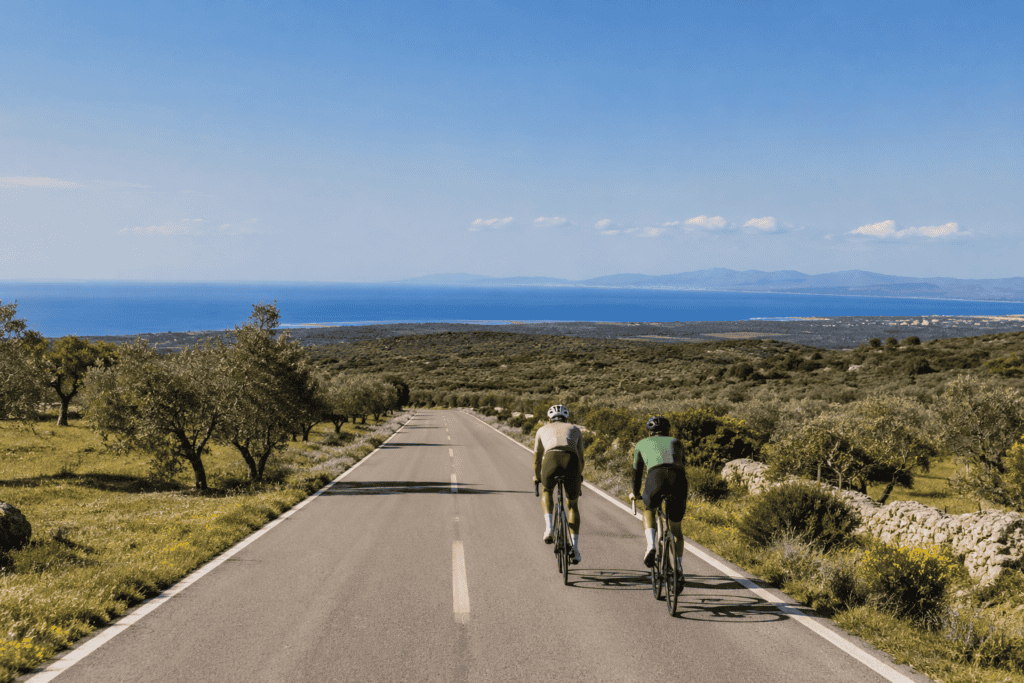
Much of Salento is flat or gently undulating, making it one of the least physically demanding parts of Puglia for leisure cycling.
The countryside contains long agricultural roads, olive groves, vineyards, dry-stone walls and small towns that can often be connected without major elevation. For riders who prefer steady distances to repeated climbing, this is usually a suitable area.
Flat terrain does not, however, guarantee an easy day. Salento is exposed to wind, and a persistent headwind can noticeably reduce speed. Coastal traffic may also increase during the summer, particularly near popular beaches and larger seaside towns.
Route selection remains important. Quiet inland roads may offer a better cycling experience than the most direct coastal connection, even when they add a few kilometres.
The Adriatic coast between areas such as Monopoli, Fasano and Ostuni includes accessible stretches of relatively level terrain, particularly across the coastal plain.
Rural roads through olive groves can provide comfortable riding, but conditions vary near towns, beach access roads and busy junctions. A road that looks convenient on a standard map may carry faster traffic or offer little space for cyclists.
The approach to inland towns can also change the difficulty quickly. Ostuni, for example, stands above the coastal plain, so a stage that begins almost flat may finish with a more noticeable climb.
The central-southern Adriatic coast is therefore generally moderate from a physical point of view, but traffic management and access to elevated towns require careful route planning.
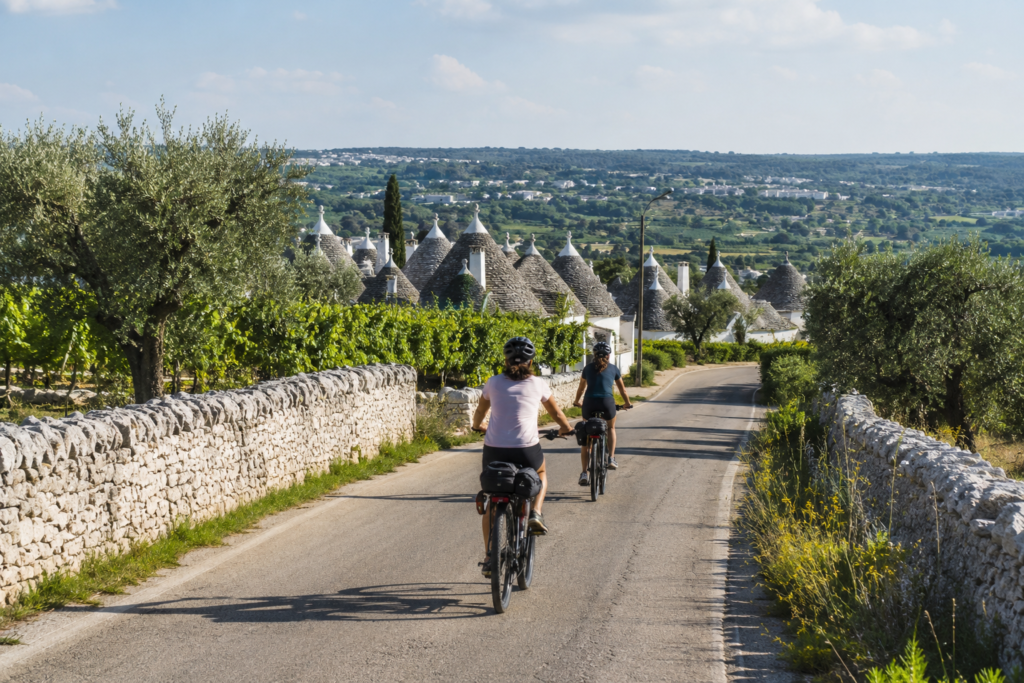
The Valle d’Itria is not mountainous, but it is more undulating than Salento and the coastal plain.
Cyclists should expect rolling countryside and repeated short climbs between trulli, vineyards, olive groves and historic towns. The individual gradients may be manageable, but their cumulative effect becomes significant over a full day.
Locorotondo, Martina Franca and Cisternino are all positioned on elevated ground. Their final approaches can be steeper than the surrounding roads, while historic centres may include narrow streets, pedestrian activity and stone paving.
For active beginners, the Valle d’Itria is usually realistic when daily stages are moderate. Riders who are not accustomed to climbing may find an e-bike helpful, especially over several consecutive days.
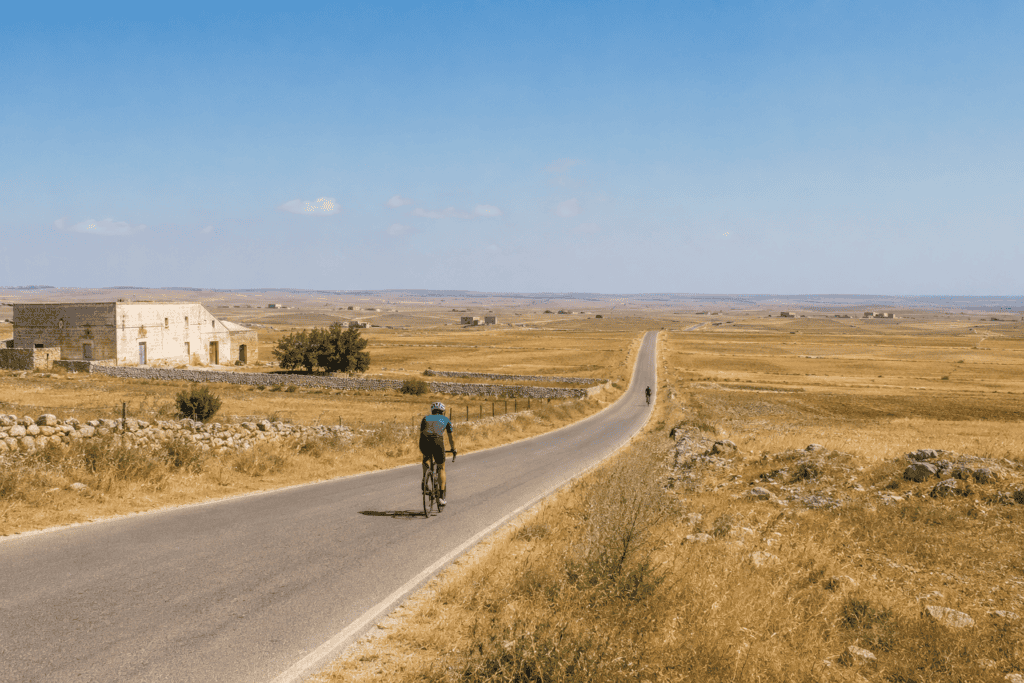
The Alta Murgia offers open plateau landscapes, long rural roads, masserie, agricultural land and broad horizons.
The terrain is generally rolling rather than mountainous, although routes can accumulate a meaningful amount of elevation over the course of the day. The main challenge is often exposure rather than steepness.
Shade may be limited, and wind can be more noticeable across open ground. Some routes also pass through long rural sections where water, food stops and alternative transport may be farther apart.
The Alta Murgia can feel peaceful and remote, which is part of its appeal. The same remoteness makes preparation more important. Riders should know where they can refill water, confirm the route in advance and avoid relying on spontaneous services appearing along the way.
Many inland routes towards Matera are more demanding than typical stages along the coastal plain.
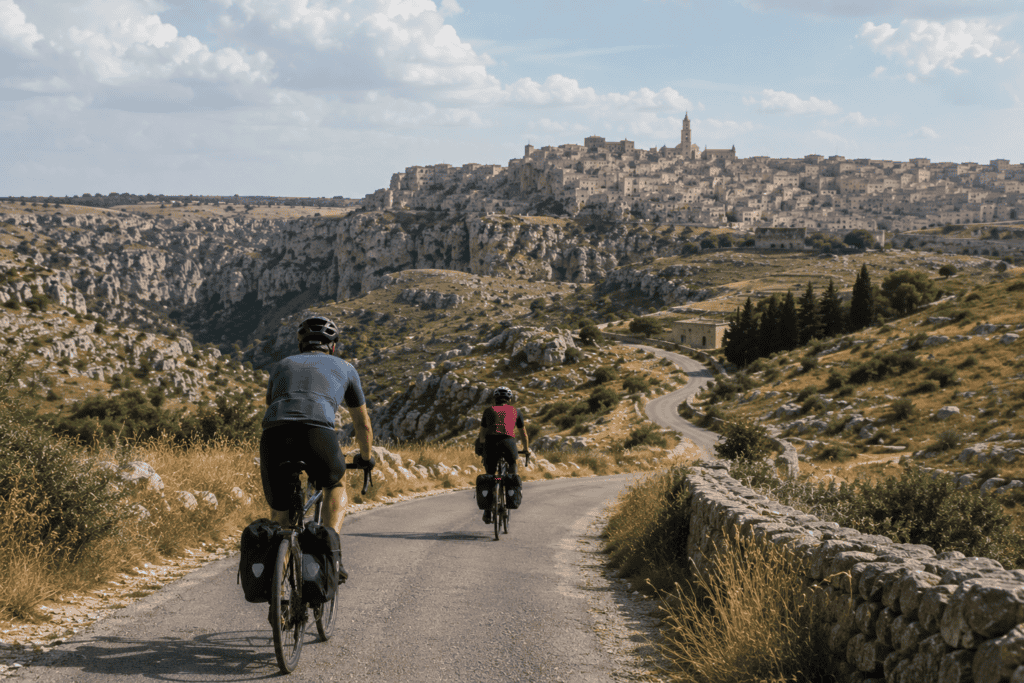
The landscape becomes progressively more varied, with rolling agricultural terrain, longer gradients and possible stretches of rural or uneven surface. Routes approaching the Murgia Materana may also encounter exposed sections and changes in elevation around gravine and viewpoints.
Matera itself is built across slopes and rocky terrain. Reaching the historic area or panoramic points can involve short but significant climbs, narrow streets and stone surfaces.
This does not place Matera beyond the reach of leisure cyclists. It means that distance, elevation and road surface should be considered together. A 45-kilometre inland stage towards Matera may demand more energy and concentration than a longer but flatter coastal ride.
Daily distance is one of the main factors affecting Puglia cycling difficulty, but kilometres should never be evaluated in isolation.
For planning purposes, a relaxed leisure stage often falls between 30 and 45 kilometres. This range can leave enough time for breaks, sightseeing and a long lunch, and may suit active beginners who are not used to several days of riding.
Stages between 45 and 60 kilometres are common for recreational cyclists with a reasonable level of fitness. They remain manageable for many travellers when the terrain is moderate and the weather is comfortable.
Distances from 60 to 75 kilometres require more time in the saddle and better endurance. They can still be suitable for experienced leisure cyclists, particularly on smooth and mostly level roads, but become more demanding when combined with repeated hills, gravel, high temperatures or headwinds.
Longer stages are generally more appropriate for fitter riders or for trips designed around sustained cycling rather than frequent cultural stops.
These are practical planning ranges, not fixed difficulty grades. Fifty kilometres on flat tarmac in spring may feel easier than 35 kilometres with repeated climbs, rough surfaces and summer heat.
A realistic stage should allow riders to reach the destination with enough energy to enjoy the town, landscape or cultural visit at the end of the day. Completing the distance should not require using every available reserve.
A rider may complete 50 kilometres comfortably during a weekend outing and still find a multi-day trip challenging.
Fatigue accumulates across consecutive days. The legs may recover reasonably well, while discomfort in the saddle, hands, neck or shoulders becomes more noticeable. Riders who are generally fit but not accustomed to spending several hours on a bicycle often underestimate this effect.
Heat and sun exposure can be more demanding than elevation. Open rural roads may offer limited shade, particularly in inland areas. High temperatures increase dehydration and make even moderate stages feel harder.
An e-bike reduces muscular effort but does not reduce exposure to the sun or the amount of time spent riding. Early departures, regular hydration and shorter stages remain important during warmer periods.
Wind can also transform a simple route. A steady headwind slows progress and increases effort. For e-bike riders, it may also increase battery consumption because higher assistance levels are used more frequently.
Road surfaces add technical fatigue. Depending on the itinerary, cyclists may encounter rough tarmac, potholes, compact gravel, loose material or irregular stone. None of these necessarily requires advanced skills, but they demand more concentration than smooth pavement.
Navigation is another part of the workload. Missing a turn, choosing an unsuitable road or discovering that a planned water stop is closed can add both distance and stress. This is why route quality often matters more than selecting the shortest line between two destinations.
A rider may complete 50 kilometres comfortably during a weekend outing and still find a multi-day trip challenging.
Fatigue accumulates across consecutive days. The legs may recover reasonably well, while discomfort in the saddle, hands, neck or shoulders becomes more noticeable. Riders who are generally fit but not accustomed to spending several hours on a bicycle often underestimate this effect.
Heat and sun exposure can be more demanding than elevation. Open rural roads may offer limited shade, particularly in inland areas. High temperatures increase dehydration and make even moderate stages feel harder.
An e-bike reduces muscular effort but does not reduce exposure to the sun or the amount of time spent riding. Early departures, regular hydration and shorter stages remain important during warmer periods.
Wind can also transform a simple route. A steady headwind slows progress and increases effort. For e-bike riders, it may also increase battery consumption because higher assistance levels are used more frequently.
Road surfaces add technical fatigue. Depending on the itinerary, cyclists may encounter rough tarmac, potholes, compact gravel, loose material or irregular stone. None of these necessarily requires advanced skills, but they demand more concentration than smooth pavement.
Navigation is another part of the workload. Missing a turn, choosing an unsuitable road or discovering that a planned water stop is closed can add both distance and stress. This is why route quality often matters more than selecting the shortest line between two destinations.
Puglia can be suitable for active beginners, but “beginner” should be defined realistically.
A complete beginner who has rarely ridden on public roads may not yet be ready for a multi-day journey. Riders should be able to brake progressively, signal, look behind without losing control, manage occasional traffic and remain balanced at low speed.
An active traveller who cycles occasionally and feels comfortable riding for two or three hours is in a stronger position. With moderate distances and an appropriate route, this type of rider can approach many areas of Puglia confidently.
Senior travellers should focus less on age and more on comfort, recovery and bicycle setup. Moderate stages, sufficient breaks and a suitable riding position are often more important than speed.
For couples with different fitness levels, an e-bike can reduce the physical gap. One rider may use electric assistance while the stronger cyclist rides a standard bicycle or selects a lower support level.
The benefits of exploring Puglia by e-bike are most noticeable on rolling terrain, longer inland stages and consecutive riding days.
An e-bike does not eliminate every difficulty. It is heavier than a conventional bicycle, requires careful handling at low speed and still needs to be controlled on gravel, narrow streets and descents. Battery use also varies with elevation, wind, assistance level, rider weight and surface, so planning should not depend on the maximum theoretical range.
A useful self-assessment is to complete two consecutive rides of approximately 35 to 45 kilometres before travelling.
The objective is not speed. It is to observe how the body responds to several hours in the saddle and whether discomfort affects the second day.
The test should include normal stops, gentle hills and some riding on public roads. Riders planning to use an e-bike should practise with one in advance, particularly if they are unfamiliar with its weight, acceleration and braking.
General fitness helps, but cycling comfort is specific. Walking, swimming and gym training do not fully prepare the body for prolonged saddle time.
Travellers should also be honest about their technical confidence. A physically fit rider who feels nervous around traffic or on uneven surfaces may find a self-guided journey more stressful than expected.
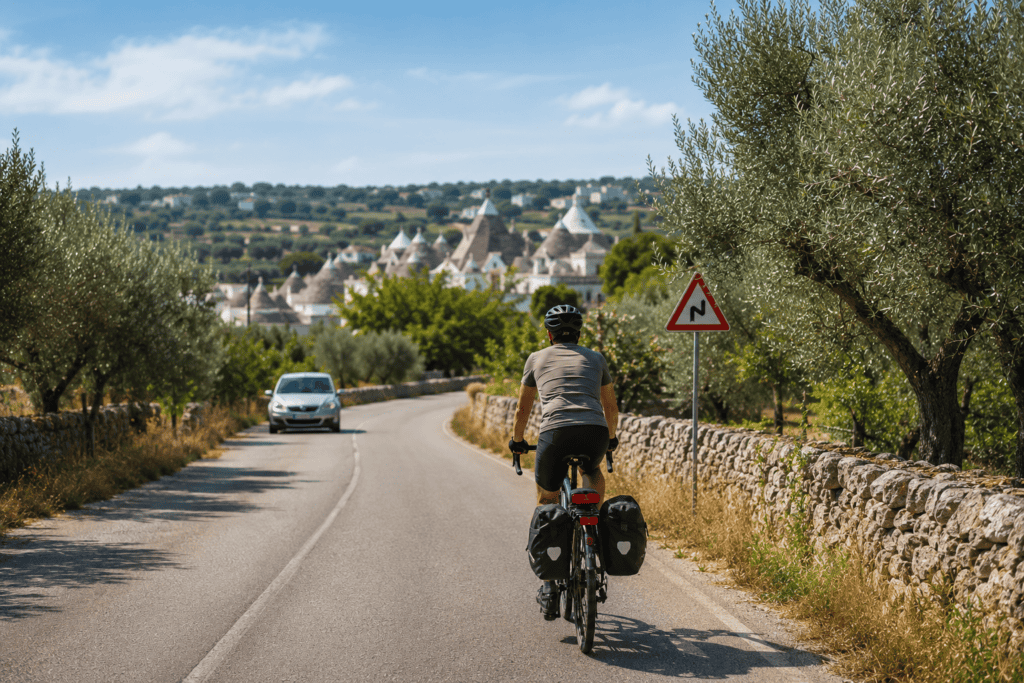
Cycling in Puglia is accessible to many leisure cyclists, but the region should not be described as uniformly flat or effortless.
Salento is generally the easiest area physically, while the central-southern Adriatic coast combines moderate terrain with occasional traffic considerations. The Valle d’Itria adds repeated short climbs, the Alta Murgia adds exposure and logistical planning, and inland routes towards Matera usually require greater attention to elevation and surfaces.
For active beginners, senior travellers and mixed-ability couples, the decisive factors are realistic daily distances, an appropriate bicycle and a route designed around suitable roads.
Travellers comparing different destinations and levels of support can review cycling holidays in Puglia and Matera to understand how terrain and daily stages vary across the region.
It depends on terrain and conditions. Fifty kilometres on smooth, mostly flat roads may be comfortable for a recreational cyclist. The same distance becomes considerably harder with repeated climbs, headwinds, rough surfaces, heat or several previous days of riding.
Puglia has cycle routes and individual protected sections, but not a continuous cycle-path network linking every destination. Many leisure itineraries therefore use minor rural roads selected to avoid busier traffic corridors.
An e-bike can be useful in the Valle d’Itria because the terrain includes repeated short climbs and elevated towns. It is especially helpful for mixed-ability couples, active seniors and riders completing several consecutive stages.
An active beginner may be able to cycle towards Matera on a carefully planned route with moderate distance and suitable surfaces. Absolute beginners should first gain confidence on public roads and practise controlling the bicycle on hills and irregular terrain.
The real difficulty of cycling in Puglia depends less on the region as a whole than on the route selected. Daily distance, elevation, road surfaces, traffic, weather and recovery time must be considered together.
A suitable itinerary should match your current experience rather than the distance you hope to complete. Choosing moderate stages, appropriate roads and the right type of bicycle makes it possible to enjoy the landscape without turning each day into an endurance test.

Discover the World, one Full Adventure at a Time!
1080 Brickell Ave - Miami
United States of America
info@travel.com
Travel Agency +1 473 483 384
Info Insurance +1 395 393 595