A weekend is an unfair amount of time for a trip: too little to cross a region, just enough to realise you have only skimmed it. Valle d’Itria is one of the few places where two days are genuinely enough — provided you choose the right vehicle. And the right vehicle is an electric bike: with an e-bike rental in Valle d’Itria you can link in a single day villages that by car would mean hunting for parking every three kilometres, and that on foot would stay out of reach. On the saddle, the weekend stops being a day trip and becomes a small journey at the pace of pedalling.
Summary (TL;DR)
- Valle d’Itria works well in two days: the main villages are just a few kilometres apart.
- On an e-bike, hills stop being a limit and the group stays together, whatever each rider’s fitness.
- Renting removes the logistics: no car, no parking, delivery of the bike to your accommodation.
- Two days cover Alberobello, Locorotondo, Martina Franca and a slice of countryside — without rushing.
- Off-season the weekend gets even better: empty roads and stops that need no reservation.
Why a weekend in Valle d’Itria asks for a bicycle
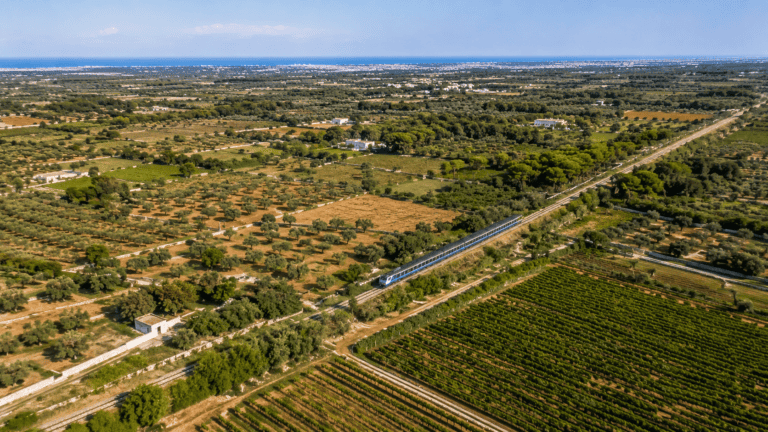
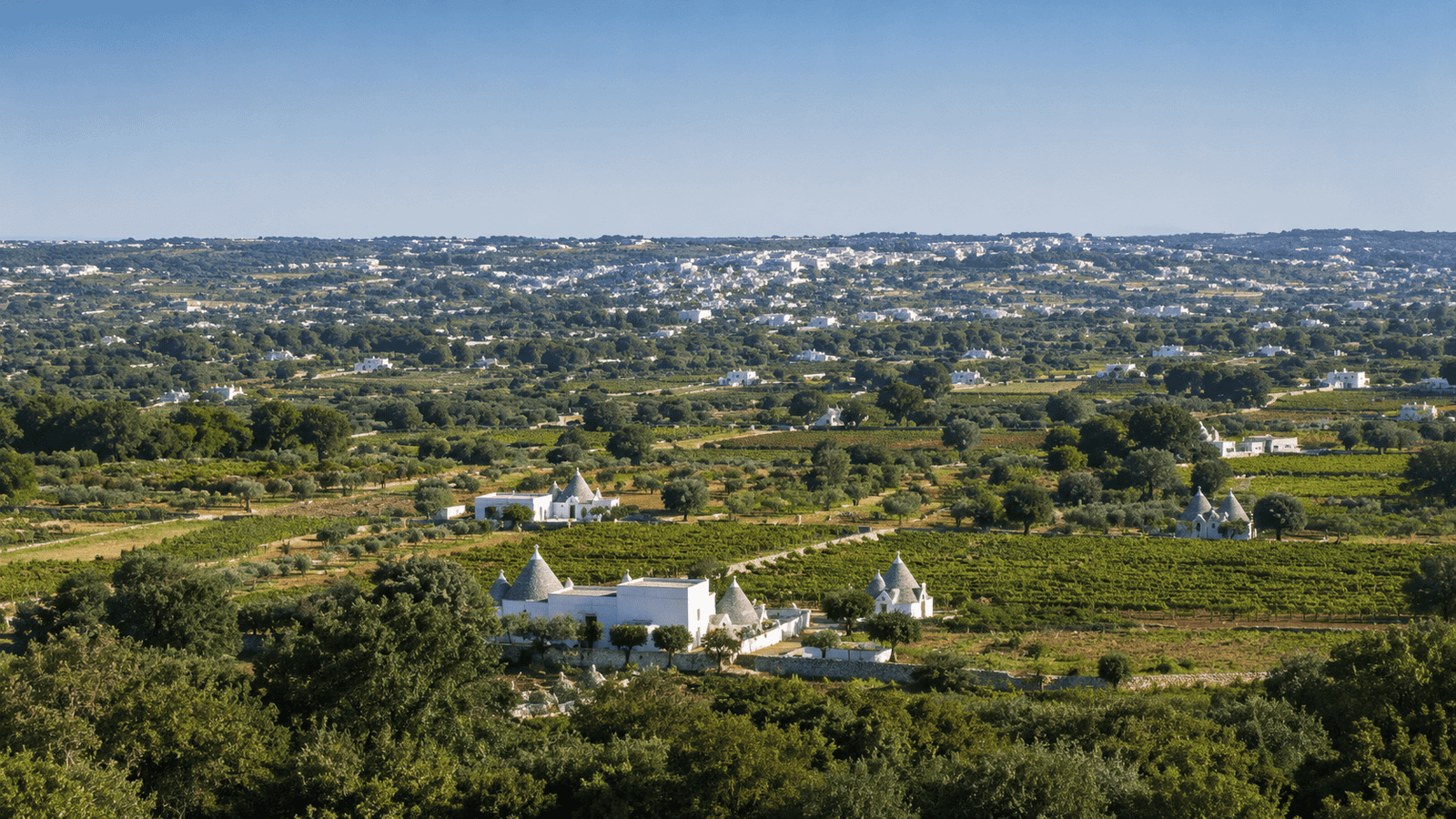
Valle d’Itria is a karst plateau dotted with trulli, dry-stone walls and white towns perched on low hills. The landscape is gentle but not flat: country roads keep rising and falling, and the distances between villages are short only if your legs cooperate. By car this turns into a sequence of quick stops and parking searches; on foot, two days barely cover one town. The bicycle is the only vehicle that sits in between — which is why cycling holidays in Puglia find their most natural ground here.
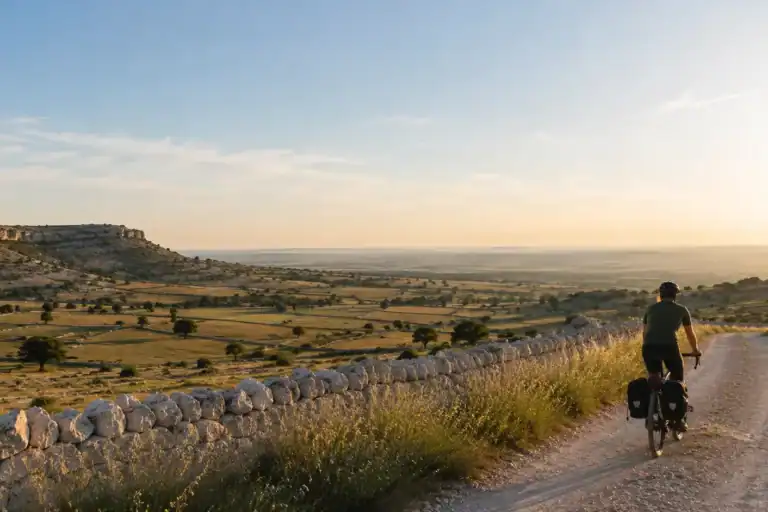
Then there is the question of rhythm. A weekend only makes sense if it is not a race: if you actually stop, if a detour is not a problem, if the length of a break is decided by the place and not by the parking meter. By bike, the stretch between Alberobello and Locorotondo becomes a patch of countryside among olive trees, not a transfer to get done. And it is precisely in those stretches that Valle d’Itria shows what the historic centres never tell: the masserie, the rows of vines, the stone walls holding the land together.
Finally, there is the crowds. On high-season weekends the famous villages fill up, and the visit shrinks to a stroll past shop windows. Leaving early and moving by bike gets you there before the cars, when the squares still belong to residents and the shutters are only half open. That advantage alone is worth the price of the rental.
An e-bike rental changes times, distances and effort
The difference between a traditional bike and an e-bike, in a place like this, is not speed: it is the number of things you get to do. With pedal assistance the ups and downs stop being a filter, and a loop linking two villages and a masseria in half a day becomes an option for everyone, not only for regular riders. If you travel with someone who is not trained, this is the variable that decides whether the weekend works or turns into a constant compromise.
The second effect is logistics. Renting means not thinking about the car for two days: the bike is delivered to your accommodation, you return it in the evening or the next morning, and the transfers between towns become rides instead of errands. A well-organised e-bike tour in Puglia lets you sleep in a masseria in the countryside and still reach the historic centres — something that without a bike would require moving the car every time.
The third effect is on the sustainability of the weekend, in the most practical sense of the word. Two days of pedal assistance cover distances that on foot would be unthinkable and by car would cost you all the details of the landscape, but without the fatigue that makes day two a problem. You arrive in the evening pleasantly tired, not destroyed, and the next morning you set off willingly instead of negotiating an early return.
The same logic works for stretching the weekend. One more day lets you drop down towards Monopoli and the coast, or push towards Matera through the inland, and both territories are reachable by bike on routes that deserve the detour. Gioia del Colle too, with its farmland and the masserie of the plateau, becomes a sensible stop for anyone who wants to add a day of agricultural landscape without giving up the villages.
Two days in the saddle: route, stops and logistics
Day one belongs to the classic loop, starting from Alberobello with the bike already delivered. You leave town towards the countryside, climb to Locorotondo between the dry-stone walls and close the ring in Martina Franca, where the baroque centre deserves an hour and a slow coffee. It is a few dozen kilometres, but with electric assistance they stay within everyone’s reach and leave time for two real stops, not a photo from the window.
Day two can go two ways. If you want to stay among the villages, aim for Cisternino and the surrounding countryside, with a detour to a masseria that opens for tastings. If you prefer open landscape, drop towards the plateau and the quieter roads, keeping in mind that off-season the light fades early and it is wise to be back with margin.
A realistic weekend plan:
- Day 1: Alberobello, countryside, Locorotondo, Martina Franca, back to your base.
- Day 2: Cisternino and a masseria, or the Murgia plateau towards Gioia del Colle.
- Evening: return the bike at your accommodation — no car transfers needed.
On the practical side you need very little: a water bottle, a layer for the descents, a charged rear light and a repair kit. The rental includes helmets, locks and phone mounts; GPS tracks replace paper maps and let you change route without losing your bearings. If the group is mixed, asking at booking time for the right frame sizes and a few tips on the quietest stretches is the difference between a weekend that works and one that grinds.
For accommodation, the smartest choice for a cycling weekend is to sleep in the countryside, in a masseria or farm stay with space to store the bikes. Rides start and end away from town traffic, dinner is a few steps from your room, and in the morning there is no car to move. If you prefer sleeping in a village, check that the property has a courtyard or a locked room for the bikes: in historic centres the lanes are narrow and pavements offer no safe alternative. Booking a few days ahead, off-season, is almost always enough.
Conclusion
For a weekend, the valley asks for a vehicle that combines freedom of movement with achievable distances, and the pedal-assist bicycle is exactly that. Renting shifts the attention from logistics to the experience: no parking, no car to move, no itineraries cut short for lack of time or legs. In two days you see far more than a map suggests — and you see it at the right pace.
Write to us with the weekend you have in mind, the number of people and your fitness level: we will put together a tailored programme, with delivery of the bike to your accommodation, GPS tracks and local assistance. We can build the classic village loop, add a day towards the coast or the inland, or organise a guided tour with someone who knows every white road of the valley. Contact us through the form on the site or the details on this page: you will get a concrete, field-tested proposal.
FAQ
How many kilometres do you ride in a weekend in Valle d’Itria?
It depends on how much you want to ride, but a relaxed plan covers short distances each day with plenty of stops. With pedal assistance you can stretch the days without fatigue, and anyone who wants to push towards the coast or the inland has room to do it.
Do I need training for a two-day e-bike tour?
No, no specific preparation is needed. Pedal assistance makes up for the hills, so the limit is not your breath but the time you want to give to sightseeing. Regular riders can simply choose longer routes or more climbs.
Where do I return the bike at the end of the weekend?
Normally at the accommodation where it was delivered, so there is no car to move. If you want to end the ride elsewhere, agree it at booking time: saying so early lets us organise the return logistics.